Here's a story I've heard more times than I can count. Someone spends three months recording a course. They edit every video, design the slides, write the workbook. Launch day comes. And almost nobody buys.
The content wasn't bad. Nobody had checked whether people actually wanted it.
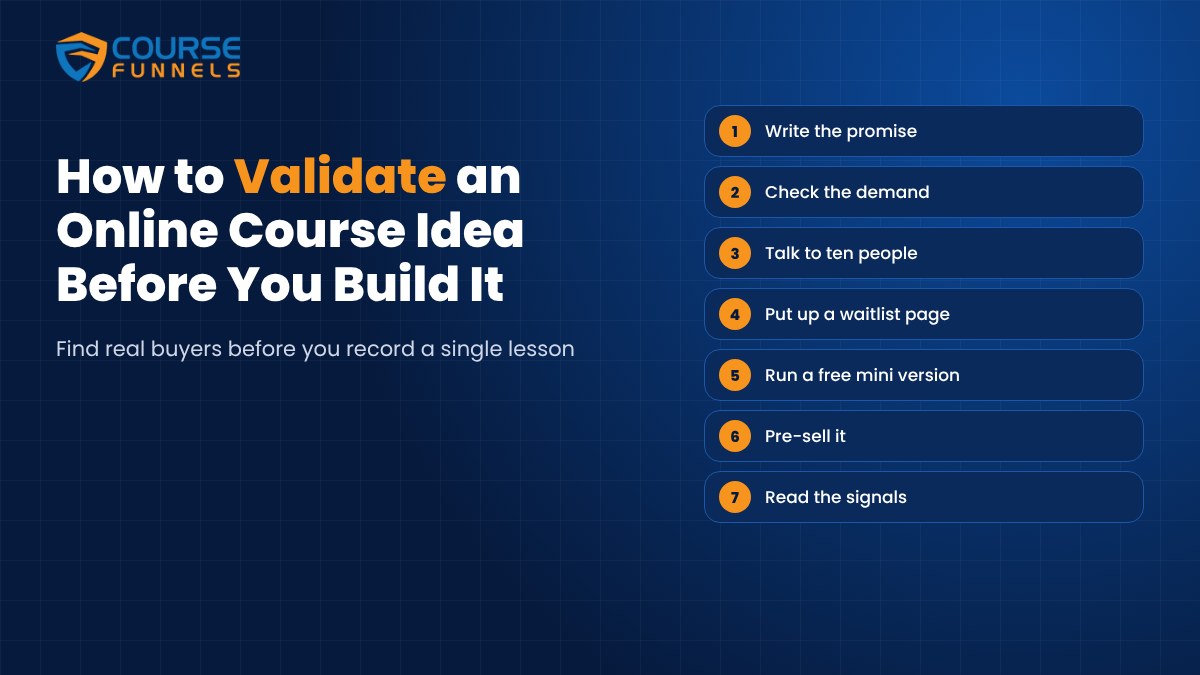
That's what course validation is for. It's the cheap, fast step you do before you build, so you know there are real buyers waiting. In this post I'll show you how to validate an online course idea in seven practical steps, including how to pre-sell it. Once your idea passes, our complete step-by-step guide to creating an online course takes you through the build itself.
Why Validation Comes Before Recording
Building a course is the expensive part. Hours of filming, editing and writing.
Validating it costs almost nothing. A few conversations, a simple page, maybe a free workshop.
So why do most people skip it? Because building feels like progress and asking feels scary. What if people say no?
Honestly, finding out "no" in week one is a gift. Finding out in month four is painful.
Step 1. Write the Promise in One Sentence
Before anything else, write down what your course will do for someone. One sentence.
Use this shape. "I help [specific person] go from [where they are now] to [where they want to be] in [a realistic time frame]."
"I help new freelance designers land their first three paying clients in 60 days" is a promise. "A course about freelancing" is a topic.
People buy promises, not topics. If you can't write the sentence, your idea isn't ready to test yet.
Step 2. Check That People Are Already Looking
You're not looking for an empty market. You're looking for proof of demand.
- Search your topic on Google and YouTube. Are people asking questions about it?
- Browse Reddit, Facebook groups and forums. Do the same problems come up again and again?
- Look at the questions in Amazon book reviews and YouTube comments. What do people still feel is missing?
- Search for existing courses on the topic. Competition is usually a good sign. It means people pay for this.
Write down the exact words people use to describe their problem. You'll use them later on your page.
Step 3. Talk to Ten Real People
This step feels old-fashioned. It's also the one that tells you the most.
Find ten people who match your promise sentence. Friends of friends, people in groups you're part of, past clients, your email list.
Ask about their problem, not your course. What have they tried? What didn't work? What would they love to be able to do? Have they ever paid for help with this?
Listen for frustration and past spending. Someone who has already bought books or courses on the topic is a much stronger signal than someone who says "sounds interesting."
Step 4. Put Up a Simple Waitlist Page
Now make it public.
Build one page that explains the promise, who it's for and what the course will cover. Add a simple email sign-up for people who want to hear when it opens.
You don't need fancy design. You need a clear headline in your audience's words and one button.
Then share it where your people already hang out. Your email list, your social profiles, the groups you've been helping.
Watch the sign-ups. Interest you can count is far more useful than interest people tell you about.
Step 5. Run a Free Mini Version
Teach a small piece of the course for free. A live workshop, a three-day email course or a short video lesson all work.
This does three things at once. It shows you which parts people respond to. It gives you real questions to build the full course around. And it builds trust with the people most likely to buy.
Pay attention to who shows up, who stays to the end and who asks "is there more?"
That last question is the one you want.
Step 6. Pre-Sell Before You Build
This is the real test. Everything else is a hint. Money is proof.
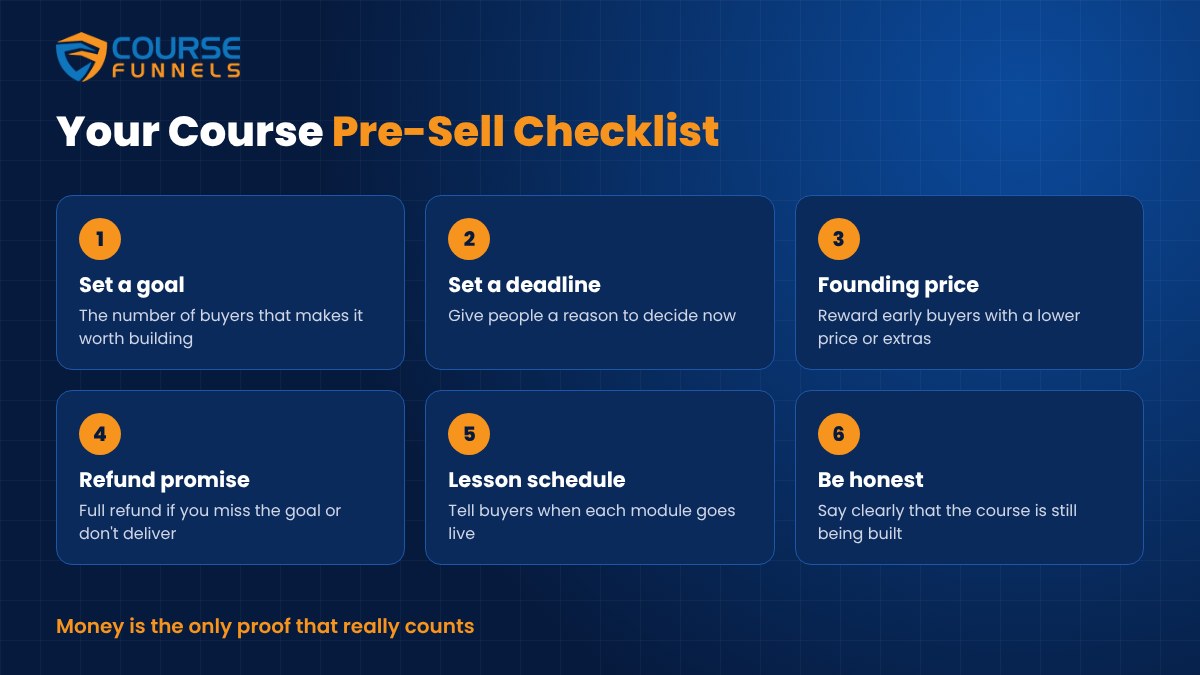
Offer the course for sale before it exists. Be honest about it. Tell people it's a founding version, when the lessons will be released and what they'll get for buying early, like a lower price or extra live calls.
A few tips that make pre-selling easier.
- Set a goal before you start, a minimum number of buyers that makes the course worth building.
- Set a deadline for the pre-sale so people have a reason to decide.
- Promise a full refund if you don't reach your goal or don't deliver.
- Release lessons on a schedule so founding students get value quickly.
If you hit your goal, congratulations. You've validated the idea and been paid to build it.
Step 7. Read the Signals Honestly
Here's the hard part. Being honest with yourself about what the numbers say.
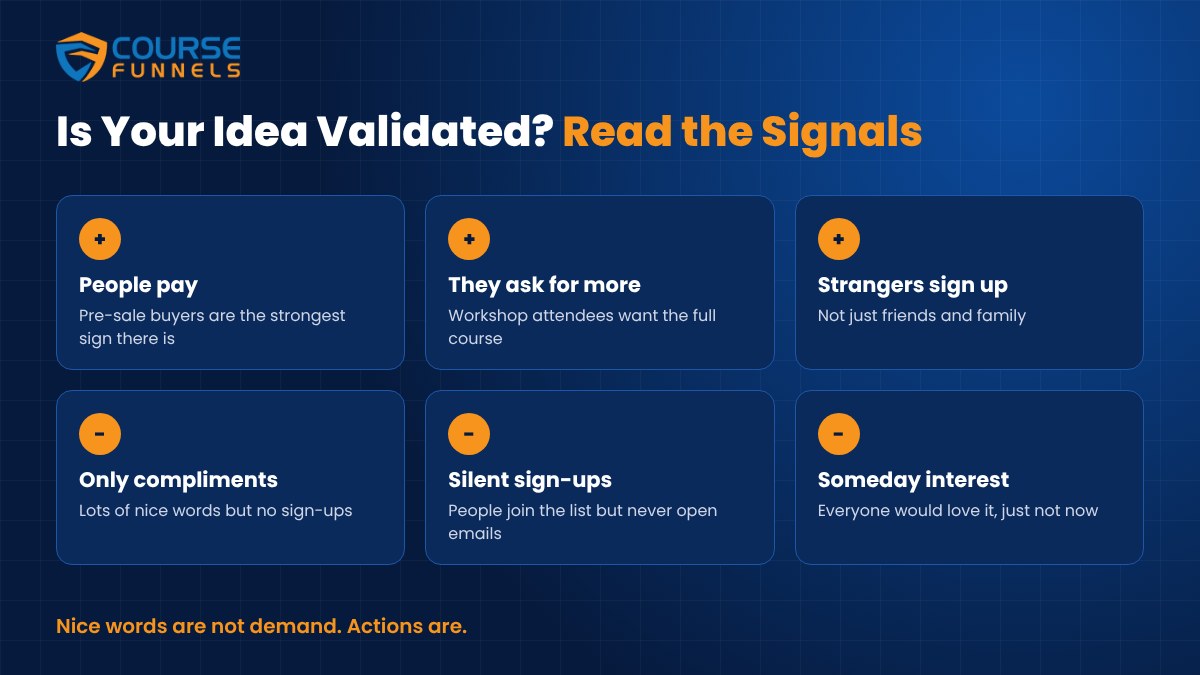
Good signs include people paying in the pre-sale, workshop attendees asking for more, waitlist sign-ups from strangers rather than just friends, and people describing the problem in emotional words.
Warning signs include lots of compliments but no sign-ups, sign-ups that never open your emails, and everyone saying they'd love it "someday."
Nice words are not demand. Actions are.
What to Do If the Idea Doesn't Pass
Don't throw it away. Adjust it.
Most failed ideas fail because the promise is too broad, the audience is too vague or the price doesn't match the result. Go back to Step 1. Narrow the audience. Make the outcome more specific. Then test again.
Sometimes the conversations from Step 3 point you to a different problem that people care about much more. That's not failure. That's market research doing its job.
How CourseFunnels Makes Validation Cheap and Simple
Every step above needs a page, an email list or a way to take payments. Stitching those together from separate tools is a hassle, and that's exactly the gap CourseFunnels fills.
It's a course builder with landing pages and email marketing built in. You can build your waitlist page and opt-in pages from ready-made templates in the drag-and-drop builder, then follow up with the built-in autoresponder.
For your free mini version, CourseFunnels can deliver a course to your leads automatically when they sign up.
When it's time to pre-sell, you can take payments through major processors like Stripe and PayPal, as well as carts like JVZoo, WarriorPlus and PayKickstart. Drip-feed lets you release lessons on a schedule, which is perfect for founding students. You can even unlock extra chapters as upsells later.
Sales reports and analytics show you how many people visit, sign up and buy, so you're reading real numbers instead of guessing. And because it installs on your own hosting, there's no revenue share on your sales.
The Elite plan costs $6.99 a month or $67 a year. The Pro plan, with unlimited courses, five sites and your own branding, costs $9.99 a month or $97 a year.
Final Thoughts
You don't need to guess whether your course will sell. You can find out, quickly and cheaply, before you record a single lesson.
Write the promise. Check the demand. Talk to real people. Put up a page. Teach a little for free. Then ask for money.
If people pay, build it with confidence. If they don't, adjust and try again.
When you're ready to build, our step-by-step guide to creating an online course walks you through the rest.
FAQs About Validating a Course Idea
How many pre-sales do I need to validate a course?
There's no fixed number. Set a goal before you start based on how much time the course will take you and what you'd need to earn for it to be worth it. If you reach that number, it's validated.
Is it okay to sell a course that doesn't exist yet?
Yes, as long as you're honest. Tell buyers it's a pre-sale, give a clear release schedule and offer a full refund if you don't deliver.
What if I don't have an audience yet?
Start with Steps 2 and 3. Go to the places where your future students already ask questions, help them for free and invite the most interested people to your waitlist.
How long does validation take?
Usually a few weeks. That's far less time than building a course nobody buys.